ISO 1716: The Short Answer
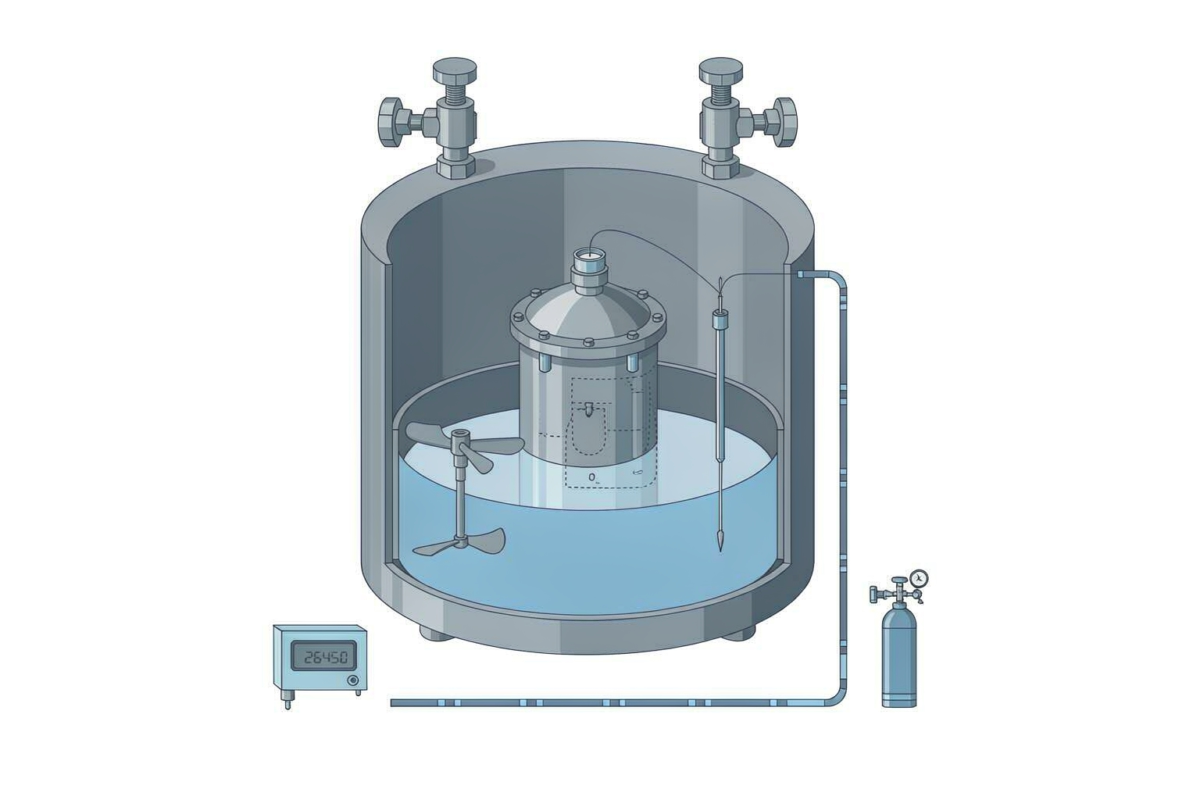
ISO 1716 measures the total energy locked inside a material: a ground sample is burned completely in high-pressure oxygen inside a bomb calorimeter, and the temperature rise of the surrounding water bath gives the gross heat of combustion (PCS) in MJ/kg. Under EN 13501-1, this single number guards the door to the non-combustible classes — Class A1 requires PCS of at most 2.0 MJ/kg for homogeneous products, and Class A2 at most 3.0 MJ/kg (with separate limits for the thin surface layers of non-homogeneous products) 12. The current edition is ISO 1716:2018, the fourth edition, published in May 2018 and confirmed at its 2023 systematic review 3. No furnace is involved, no flame is observed: the test asks one question — if this product burned completely, how much energy would it release?
What the Test Is — and Why a Number Beats a Furnace
ISO 1716 specifies the determination of the gross heat of combustion (QPCS) of products at constant volume in a bomb calorimeter, intended for solid products; liquids can be tested with similar equipment under the conditions of ASTM D240 [3]. Where the ISO 1182 furnace observes how a material behaves at 750 °C, the bomb calorimeter computes what a material contains: the sample is ground to powder, dried, pressed into a crucible with an ignition wire, and burned in roughly 30 bar of oxygen — conditions hot enough and oxygen-rich enough for complete combustion, which is precisely the point. Real fires never burn anything completely; the regulation uses the complete-combustion figure as an absolute worst-case energy budget for the product [1][2].
That worst-case logic explains the class thresholds. A1 (2.0 MJ/kg) admits products whose total chemical energy is negligible — stone wool, glass, ceramics. A2 (3.0 MJ/kg) admits products with small amounts of binder or resin: enough organic content to hold mineral fibres together, not enough to feed a fire. Each additional MJ/kg is budgeted by the regulation, and the bomb measures the budget [1][2].
The Apparatus: Bomb, Water Bath, Benzoic Acid
The instrument chain is compact, and each element has a compliance function [2][3]4:
| Component | Key requirements |
|---|---|
| Bomb | Stainless steel pressure vessel, ~(300±50) ml, pressure-rated well above the 3 MPa fill; two valves (fill + vent) |
| Oxygen supply | 99.5 % purity, filled to 3.0 MPa (30 bar); slow fill to avoid igniting the sample |
| Calorimeter vessel | Water bath surrounding the bomb (~2–3 L); stirring for uniform temperature |
| Temperature measurement | High-resolution (0.001 K class) sensor; drift-controlled equilibrium before firing |
| Ignition | Fuse wire (or cotton thread assist); its combustion energy subtracted from the result |
| Crucible | Platinum, nickel, stainless steel or silica, wall ~1–1.5 mm |
| Calibration substance | Certified benzoic acid — the internationally agreed reference with a known heat of combustion |
| Corrections software | Regnault-Pfaundler cooling correction, nitric-acid formation correction, fuse-wire subtraction [4] |
Calibration is where instruments separate. The calorimeter’s heat capacity (water equivalent) is not a specification-sheet number — it is determined experimentally by burning certified benzoic acid through the exact sample procedure, and it must be re-established after component changes, sensor repair or long shutdown, with routine checks in between [4]. A laboratory whose software “linearly converts” temperature rise without the standard’s correction chain (cooling curve, nitric acid, fuse wire) produces numbers that look like PCS but will not survive an accreditation assessment [4]. Our oxygen bomb calorimeter ships with the benzoic-acid calibration workflow and the full correction chain built into its software, because the corrections are the method.
Specimens: Grind, Dry, Weigh, Repeat
Sample preparation turns a building product into a measurable powder, and the rules protect the result’s representativeness [2][3]:
| Step | Rule |
|---|---|
| Sampling | ≥ 50 g for a homogeneous product or a substantial component; ≥ 10 g for a non-substantial (thin) component; take ≥ 5 pieces across the full thickness [2] |
| Substantial vs non-substantial | A layer ≥ 1.0 mm thick or ≥ 1.0 kg/m² is substantial (tested on its own); thinner layers are non-substantial with MJ/m² limits [2] |
| Grinding | To powder ≤ 1 mm; homogeneous products ground directly, layered products ground per component |
| Drying | Oven-dried to constant mass (≈ 105 °C) to remove moisture before testing [4] |
| Test specimen | ~0.5 g per pellet, from the ground powder; three specimens per component by the crucible or “cigarette” method [2] |
| Combustion aids | Benzoic acid or paraffin oil added for hard-to-burn samples, its known energy subtracted 5 |
| Runs per component | Five parallel determinations, reported as means [2][5] |
The substantial/non-substantial split deserves a second read because it decides the paperwork. A 0.8 mm decorative foil on a mineral board is non-substantial: it gets a MJ/m² limit (4.0 for A2), not the 3.0 MJ/kg figure, because a thin layer’s mass is negligible but its surface energy is not [2]. Getting this split wrong in the lab order produces the wrong limit comparison — and a rejected classification file.

Reading a PCS Report Like a Classifier
A conforming PCS report carries more than one number per product, and reading it properly takes thirty seconds once you know the layout. For a homogeneous product, expect a single PCS figure in MJ/kg, the mean of the parallel runs, with the individual determinations and the calibration record behind them. For a non-homogeneous product, expect one line per substantial component plus per-layer MJ/m² values for the non-substantial films, ending in a computed whole-product figure where the regulation demands one [2]. Three reading habits catch most problems: check that the drying state is stated (wet-basis numbers are not comparable), check that each component’s limit column matches its substantiality class, and check that combustion aids appear with their subtracted values rather than vanished silently. When mineral wool quotes 0.8 MJ/kg and FR PVC quotes 19 MJ/kg, both are honest numbers — they simply answer different specification questions, which is why the PCS column sits beside the furnace and SBI columns in a complete classification file rather than replacing them [1].
Safety and Daily Operation in the Calorimeter Room
A bomb pressurised to 30 bar with pure oxygen deserves engineering respect, and the daily routine that earns it is short. Inspect the bomb sealing rings and threads on the calibration schedule, not only when a leak appears; keep the oxygen regulator and its hoses on a documented replacement cycle; and purge the bomb after filling rather than relying on a single fill, because residual nitrogen inflates the nitric-acid correction and quietly biases every result [4]. The ignition step uses a fuse wire whose energy is subtracted from the result — weight-consistent wire lots and a record of each firing keep that subtraction honest. Around the instrument, the room needs nothing exotic: a stable temperature band (the GB/T 14402-2026 discipline quotes 10–35 °C at up to 80 % relative humidity), a bench that does not vibrate, and an extraction point over the bomb for post-firing venting [4]. Laboratories that log every firing — sample mass, wire lot, oxygen fill, corrected result — produce audit files that close on first review, which is the cheapest form of accreditation insurance available.
The A1/A2 Thresholds — the Numbers in the Regulation
EN 13501-1 sets different PCS limits for homogeneous products, substantial components, non-substantial layers and the product as a whole [2]:
| Class | PCS limit (homogeneous products & substantial components) | PCS limit (external non-substantial layers) | PCS limit (internal non-substantial layers) | Product as a whole |
|---|---|---|---|---|
| A1 | ≤ 2.0 MJ/kg | ≤ 2.0 MJ/m² | ≤ 1.4 MJ/m² | — |
| A2 | ≤ 3.0 MJ/kg | ≤ 4.0 MJ/m² | ≤ 4.0 MJ/m² | ≤ 3.0 MJ/kg |
One A1 wrinkle rewards careful reading: an external non-substantial layer with PCS ≤ 2.0 MJ/m² can alternatively be accepted if the product passes EN 13823 with FIGRA ≤ 20 W/s, LFS < edge, THR600s ≤ 4.0 MJ, s1 and d0 — an SBI-based escape clause for products whose thin coatings carry slightly more energy [2]. Note also what ISO 1716 measures and what it does not: the gross figure includes the latent heat of vaporisation of the water formed in combustion; the net heat of combustion (PCI), which excludes it, is calculated in Annex A of the standard when a specification asks for it [3].
When a Specification Asks for Net Instead of Gross
Net heat of combustion appears in energy-focused specifications — fuels, waste-derived fuels, certain transport applications — because engines and boilers never recover the water’s latent heat, so the net figure describes usable energy. Reaction-to-fire work stays on the gross figure for the opposite reason: the classification wants the absolute worst case, water’s condensation included [3]. The two numbers differ only by the hydrogen content of the sample multiplied by a fixed latent-heat factor, so the same experimental run supports both — which is why a report can carry the PCI line without re-testing. The expensive mistake is quoting one where the other is demanded: an A2 file quoting PCI reads as if the product contains less energy than the regulation’s accounting assumes, and a fuel contract quoting PCS overstates the deliverable energy. Annex A exists precisely so one bomb, one grinding, one set of runs can serve both document trails with a declared basis [3].
Where ISO 1716 Sits in the Classification Chain
The bomb calorimeter never acts alone at the top of the ladder. Class A1 requires both ISO 1716 (PCS ≤ 2.0 MJ/kg) and the ISO 1182 furnace (ΔT ≤ 30 °C, no sustained flaming, mass loss ≤ 50 %); Class A2 requires one of the two tests plus the SBI [1][2]. Our ISO 1182 non-combustibility guide covers the furnace side, and the EN 13501-1 Euroclass guide maps every class to its test set. For laboratories, the practical consequence is procurement, not theory: the furnace and the bomb are a paired purchase, delivered with compatible data handling, because every A1/A2 file quotes both reports side by side.
Two boundary clarifications prevent misfiled test reports. First, ISO 1716 is a reaction-to-fire input test, not a fire class: a PCS number on a datasheet is not an A2 declaration, and suppliers quoting “2.8 MJ/kg — passes” without a classification context are quoting half an argument. Second, the test is deliberately insensitive to geometry: a ground powder cannot describe how panels, joints or cavities behave in a real fire, which is exactly why the SBI and the furnace exist [1].
PCS Beyond EN 13501-1: Where Else the Number Decides
The same instrument serves specification systems far beyond the Euroclass ladder, and knowing the neighbours helps laboratories price their services. In China, GB 8624’s A-class declarations require the GB/T 14402 heat-of-combustion evidence alongside GB/T 5464 furnace results — the same pair, on national paperwork 6. In the maritime world, IMO FTP Code references the calorific measurement for defined products; in coal, fuel and waste-derived-fuel markets, sibling standards (ISO 1928, ASTM D5865, ASTM D240, ASTM E711) use the same bomb hardware with method-specific corrections [3][5]. For a laboratory, this means the calorimeter’s utilisation is rarely the bottleneck: construction, energy and materials clients all feed the same instrument. What changes between clients is only the paperwork — the correction chain, reporting units and calibration discipline stay constant, which is precisely why buying a calorimeter whose software implements multiple methods is cheaper than buying a second instrument later [5].
GB/T 14402-2026: China Adopts the 2018 Edition
China’s national heat-of-combustion method was revised in the same batch as GB/T 5464: GB/T 14402-2026, published 31 March 2026 and in force from 1 October 2026, is a modification of ISO 1716:2018 and fully replaces GB/T 14402-2007 [6]. For manufacturers serving the Chinese market, three consequences follow:
| Item | GB/T 14402-2007 (old) | GB/T 14402-2026 (current) |
|---|---|---|
| International edition basis | ISO 1716 predecessors | ISO 1716:2018 (modified adoption) |
| Status since 2026-10-01 | superseded | current for GB 8624 A-class heat-of-combustion evidence |
| Calibration discipline | legacy procedures | benzoic-acid calibration with defined repeat conditions and environmental band (10–35 °C, ≤ 80 % RH) [4][6] |
Laboratories that ran GB/T 14402-2007 reports after 1 October 2026 no longer demonstrate conformity for new Chinese certifications. Exporters who test in China and declare in Europe should ask one question of their laboratory: which international edition is your calorimeter procedure aligned to now that both the GB and EN routes share the 2018 edition [4][6]?
Buying a Bomb Calorimeter: What to Check
Procurement questions for calorimeters are calibration questions [2][4]:
| Item | What to require |
|---|---|
| Calibration workflow | Certified benzoic-acid routine with repeat-condition rules built into the software — not a spreadsheet |
| Correction chain | Regnault-Pfaundler cooling correction, nitric-acid and fuse-wire corrections automatic |
| Bomb integrity | Pressure rating well above the 3 MPa fill, dual valves, leak-test record |
| Resolution | Temperature resolution at the 0.001 K class with controlled equilibrium detection |
| Throughput | Per-day sample count matching your classification campaign (five runs per component adds up) |
| Documentation | Calibration certificates traceable to national standards; audit-ready raw curve storage |
The five-run-per-component rule multiplies quickly on non-homogeneous products — each substantial component and each non-substantial layer needs its own determinations — so throughput and automation are budget lines, not luxuries, for laboratories serving A1/A2 classification programmes [2][5].

Common Mistakes With ISO 1716
| Mistake | Consequence | What to do |
|---|---|---|
| Treating a PCS number as an A2 declaration | Half an argument; specifier rejects the file | Order the classification, not just the test |
| Skipping the benzoic-acid calibration cycle | All results shift systematically | Follow the standard’s calibration and repeat rules [4] |
| Comparing MJ/kg against a MJ/m² limit | Wrong limit table; wrong verdict | Map components to substantial/non-substantial first [2] |
| Reporting gross when the spec asks net | PCI vs PCS mismatch | Annex A calculation when required [3] |
| Moisture left in the sample | PCS diluted; borderline products pass falsely | Dry to constant mass before pelleting [4] |
Frequently Asked Questions
What is the current version of ISO 1716?
The current edition is ISO 1716:2018, the fourth edition, published in May 2018 by ISO/TC 92/SC 1 and confirmed at its 2023 systematic review. It replaced ISO 1716:2010. The European adoption is EN ISO 1716:2018, and China’s GB/T 14402-2026, in force since 1 October 2026, is a modified adoption of the same 2018 edition.
What is the difference between gross and net heat of combustion?
The gross heat of combustion (PCS, QPCS) includes the latent heat of vaporisation of all water formed during combustion — it is the total energy released when combustion products cool back to the starting temperature. The net heat of combustion (PCI) subtracts that latent heat because in real fires the water leaves as vapour. ISO 1716 measures the gross figure directly and specifies the net calculation in its Annex A when a specification requires it.
Why does EN 13501-1 use MJ/m² limits for some layers?
Thin layers of a non-homogeneous product contribute negligible mass but meaningful energy per unit area, so the regulation limits them in MJ/m² rather than MJ/kg. A layer thinner than 1.0 mm and lighter than 1.0 kg/m² is non-substantial: Class A1 caps external non-substantial layers at 2.0 MJ/m² and internal ones at 1.4 MJ/m², while Class A2 allows 4.0 MJ/m² for both.
How many test runs does ISO 1716 require?
Three test specimens of about 0.5 g each are prepared per component, and classification practice applies the criteria to five parallel determinations reported as means. Sampling needs at least 50 g from each homogeneous product or substantial component, and at least 10 g from each non-substantial layer, all ground to a powder of at most 1 mm before pelleting.
Why is benzoic acid used for calorimeter calibration?
Benzoic acid is the internationally agreed calibration substance because it is available in certified reference grade, burns completely and reproducibly, and has a precisely known heat of combustion. Burning it through the exact sample procedure determines the calorimeter’s heat capacity (water equivalent), which converts every subsequent temperature rise into joules. Without that calibration, all results shift systematically.
Does ISO 1716 alone give a Class A1 or A2?
No. Class A1 requires passing both ISO 1716 (PCS ≤ 2.0 MJ/kg for homogeneous products) and the ISO 1182 non-combustibility furnace test; Class A2 requires one of the two plus the SBI test EN 13823. The PCS number is the energy-budget input to the class, never the class itself.
What changed in GB/T 14402-2026?
GB/T 14402-2026, published 31 March 2026 and in force from 1 October 2026, fully replaces GB/T 14402-2007 and is a modified adoption of ISO 1716:2018, aligning the Chinese method with the international 2018 edition. It reinforces benzoic-acid calibration discipline with defined repeat conditions and an environmental band of 10–35 °C and up to 80 % relative humidity, so A-class heat-of-combustion evidence in China now rests on the same calorimetric practice as European EN ISO 1716:2018 files.
Conclusion: The Two-Instrument Bottom Line
- ISO 1716 answers “how much energy does this product contain” — the worst-case number behind every A1/A2 decision.
- Buy the furnace and the calorimeter as a pair: every A1 file quotes both reports.
- Calibrate with certified benzoic acid on the standard’s schedule; the corrections chain is the method.
- Track the editions: ISO 1716:2018, EN ISO 1716:2018 and GB/T 14402-2026 now describe one method on three paper trails.
BRT manufactures oxygen bomb calorimeters with the benzoic-acid calibration workflow and full correction chain built in, alongside the ISO 1182 furnaces they pair with. Tell us your classification programme, and our engineers will size the calorimeter and furnace set to your sample volume.
About BRT: Shenyang Baoruitong Automation Equipment Co., Ltd. (BRT) manufactures fire and flammability testing equipment — including oxygen bomb calorimeters, non-combustibility furnaces and complete reaction-to-fire suites — for laboratories in China and export markets. This guide was prepared by the BRT engineering team from the published editions of the standards cited below.