


Single Burning Item Test System (SBI)
The JCDT Single Burning Item (SBI) Test System is a professional-grade fire testing apparatus engineered to evaluate the reaction-to-fire performance of building products when exposed to thermal attack by a single burning item.
Main Functions:
- Fire Performance Diagnostics
- Smoke & Toxicity Analysis
- Automated Data Acquisition
Testing Standards:
- EN 13823
- EN 13501-1 (Euroclass A2, B, C, D classification testing)
Pre-Shipment & Testing
Factory Acceptance Test (FAT) & Pre-Shipment Inspection
Real Machine Testing Videos & Test Reports Available
Warranty & Tech Support
1-Year Warranty & Lifetime Remote Technical Support
Complete English Manuals & Video Tutorials Provided
Certification & Customization
Third-Party Calibration Certificates Available
Full OEM & ODM Customization for Specific Lab Needs
Global Export & Logistics
Worldwide Express & Sea/Air Freight Shipping
Complete International Export Documentation Provided
What Is the Single Burning Item (SBI) Test?
The Single Burning Item (SBI) is the European reference test method defined in EN 13823 for evaluating the reaction-to-fire performance of building products, excluding floorings. It simulates a realistic fire scenario in which a single burning item — such as a wastepaper basket in the corner of a room — exposes the adjacent wall or ceiling lining to a controlled thermal attack. The SBI results (heat release, smoke production and lateral flame spread) are the primary data source for assigning Euroclasses A2, B, C and D under EN 13501-1, which in turn are required for CE marking of construction products in the European market.
What Is the JCDT Single Burning Item Test System?
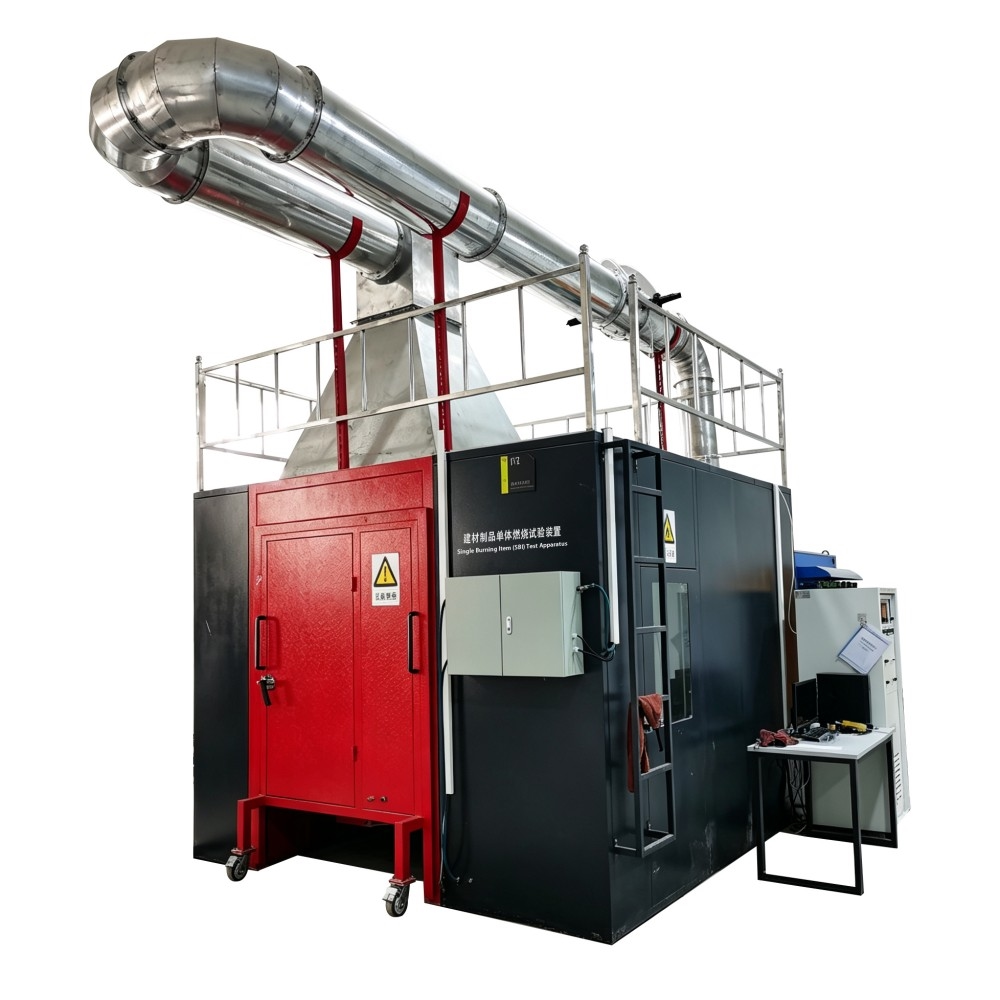
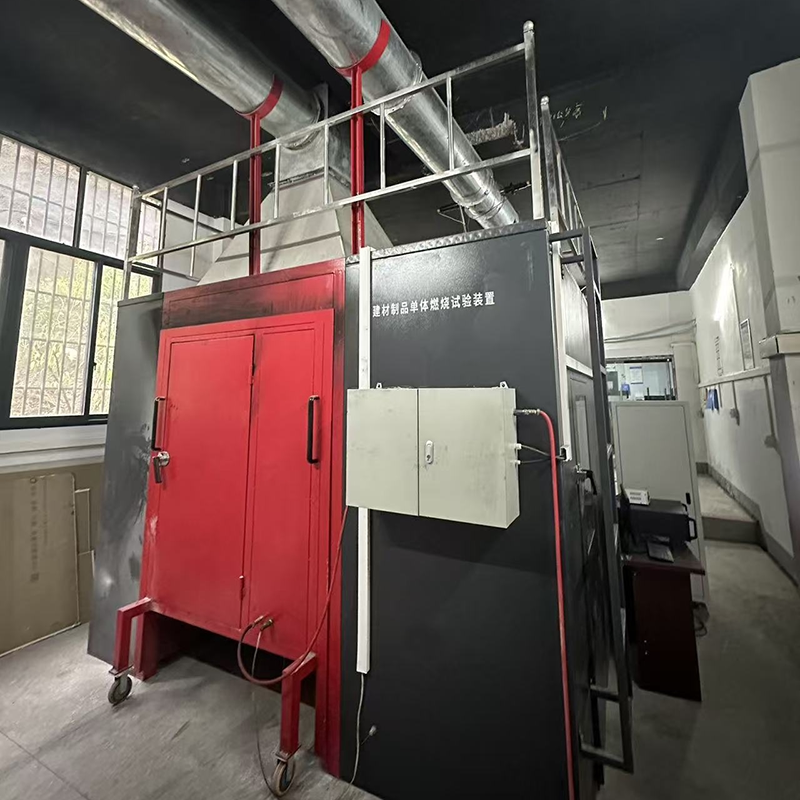
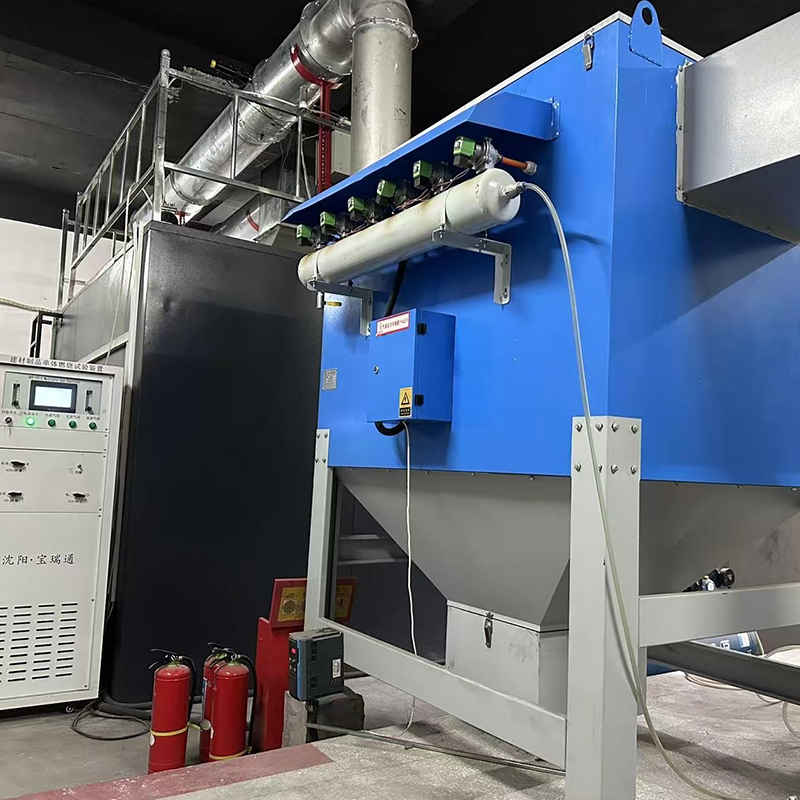
The JCDT Single Burning Item (SBI) Test System is a fully integrated laboratory testing apparatus designed to comply with EN 13823, EN 13501-1 and GB/T 20284. By simultaneously measuring heat release, smoke production, lateral flame spread and flaming droplets/particles under controlled combustion conditions, the system delivers the authoritative data set required for reaction-to-fire classification and international fire safety certification of construction products.
-

- Single Burning Item Testing Equipment
-
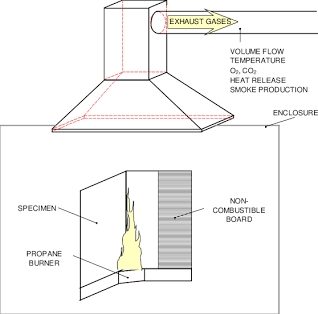
- Single Burning Item (SBI) Test System Diagram

-

- Single Burning Item (SBI) Test Apparatus System Architecture Diagram Reference
Applicable Materials
The JCDT SBI Test System is suitable for testing a wide variety of building and construction products (excluding floorings), including:
- Wall cladding & coverings: gypsum boards, decorative wall panels, timber cladding and composite exterior panels.
- Thermal insulation products: polyurethane (PU), expanded polystyrene (EPS), extruded polystyrene (XPS) and rock wool insulation.
- Pipe insulation & ductwork: flexible and rigid thermal insulation materials for mechanical systems.
- Pipes & electrical cables: construction conduits and exposed piping systems (under specific installation profiles).
Main Functions and Modules
- Combustion & trolley system: dual-burner configuration (main trolley burner and auxiliary frame burner) with automatic propane gas flow control and ignition to ensure a uniform heat flux on the specimen corner.
- Exhaust & gas sampling system: stainless steel exhaust duct, suction hood and high-precision sampling probe transport flue gases efficiently for continuous analysis.
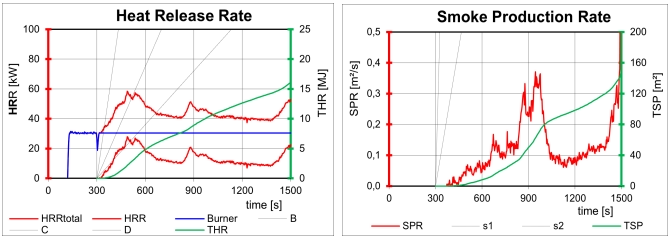
- Oxygen consumption & heat release analysis: a paramagnetic O2 analyzer and a non-dispersive infrared (NDIR) CO2 analyzer dynamically calculate the Heat Release Rate (HRR) and Total Heat Release (THR).
- White-light smoke measurement system: a photometer with a stabilized lamp and photocell measures the Smoke Production Rate (SPR) and Total Smoke Production (TSP).
- Automated data acquisition & control software: PLC/PC-based software provides real-time data display, curve plotting, automatic calculation of FIGRA0.2MJ, FIGRA0.4MJ and SMOGRA, and standard-compliant test report generation.
Test Graphs
Technical Parameters
| Parameter | Technical Specification |
|---|---|
| Applicable standards | EN 13823; EN 13501-1 (A2, B, C and D) ; GB/T 20284 (GB 8624 classification) |
| Main burner heat output | 30.7 ± 0.8 kW (propane, purity ≥ 99.5%) |
| Oxygen (O2) analyzer | Paramagnetic, range 0–25%, response time T90 < 3 s |
| Carbon dioxide (CO2) analyzer | NDIR, range 0–10% |
| Smoke measurement system | White-light photometer, lamp voltage stability within ± 0.1% |
| Exhaust flow rate | Adjustable 0.50–0.65 m³/s (nominal 0.60 m³/s) |
| Temperature measurement | K-type thermocouples for ambient and exhaust duct temperature profiling |
| Power supply & gas requirement | AC 380 V, 50 Hz, 3-phase; commercial-purity propane and compressed air |
Important Notes
- Laboratory ventilation & extraction: the laboratory must be equipped with a dedicated smoke extraction hood and adequate fresh-air supply to prevent gas accumulation during testing.
- Gas supply safety: high-purity propane fuel lines must be fitted with flame arrestors, gas leak detectors and emergency shut-off valves.
- Calibration requirements: regular calibration of the gas analyzers (O2/CO2), the light-attenuation system and the burner heat output, using standard calibration procedures, is necessary to maintain measurement accuracy.
- Sample preparation: test specimens must be conditioned in accordance with EN 13238 (23 ± 2 °C, 50 ± 5% relative humidity) prior to mounting on the SBI corner trolley.
FAQ
Q: How do I perform a test using the SBI Test System (BS EN 13823)?
Operating the Single Burning Item (SBI) Test System involves 3 straightforward steps:
- Specimen Setup: Mount two conditioned specimen wings (1500×1000 mm and 1500×500 mm) onto the corner trolley, and set exhaust volume flow to 0.50–0.65 m³/s.
- Run the 21-Minute Test: Position the trolley under the hood to record baseline data. Ignite the main 30.7 kW propane burner at 5 minutes (t = 300 s) for a 20-minute thermal exposure while observing flame spread and smoke development.
- Shutdown & Analysis: Shut off gas at t = 1500 s, purge remaining combustion gases, and inspect char depth. The software automatically calculates key ratings including FIGRA, SMOGRA, HRR, and TSP.
View the full SBI Test System operating guide


admin –
Very good!