


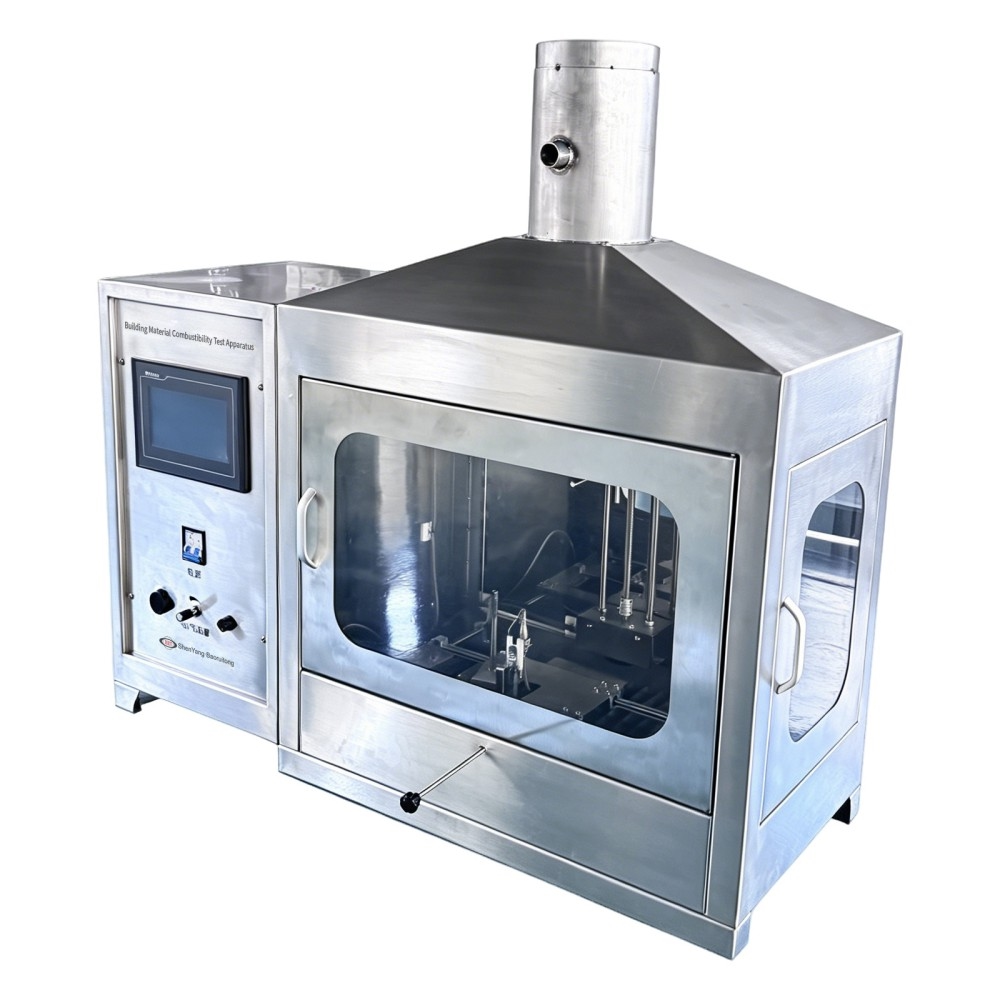

Single-Flame Source Test Apparatus
The JCKR Small Flame Source Tester is a high-precision ignitability tester engineered to evaluate the reaction-to-fire performance of building materials when subjected to direct flame impingement.
Main Functions:
- Combustibility & Ignitability Evaluation
- Automated Ignition & Timing Control
- Multi-Angle Observation & Data Logging
Testing Standards:
- ISO 11925-2
- EN 13501-1 (Class B, C, D, E and F)
- DIN 4102-1 (Class B2)
- EN 45545-2
- DIN 54837
Pre-Shipment & Testing
Factory Acceptance Test (FAT) & Pre-Shipment Inspection
Real Machine Testing Videos & Test Reports Available
Warranty & Tech Support
1-Year Warranty & Lifetime Remote Technical Support
Complete English Manuals & Video Tutorials Provided
Certification & Customization
Third-Party Calibration Certificates Available
Full OEM & ODM Customization for Specific Lab Needs
Global Export & Logistics
Worldwide Express & Sea/Air Freight Shipping
Complete International Export Documentation Provided
What Is the JCKR Single-Flame Source Test Apparatus?
-

- EN ISO 11925-2 Small Flame Source Test Ignitability Tester

-
- EN ISO 11925-2 Small Flame Source Test Ignitability Tester

-
- Small flame ignitability tester for EN ISO 11925-2, the test that decides Euroclass E.
What Is the Single-Flame Source Test?
The Single-Flame Source Test (also called Small Flame Source Test) is a standardized fire testing method designed to evaluate the ignitability of building products and materials when subjected to direct, small-scale flame impingement. Governed by key international standards such as ISO 11925-2, this test determines a material’s reaction-to-fire behavior, assessing how easily a product ignites and whether flames spread vertically under controlled laboratory conditions.
Applicable Materials of ISO 11925-2 Single-Flame Source Test
- Applicable to the burning behaviour classification and judgement of building materials, decorative materials, and their products.
- Mainly used for the evaluation of flame-retardant materials and combustible materials (such as classes B1 and B2).
- Applicable to essentially flat products and materials evaluated under international standards like EN 13501-1, DIN 4102-1 (Class B2), EN 45545-2, and DIN 54837.
Main Functions and Modules
- Full stainless-steel cabinet, rust-proof and corrosion-resistant.
- Large 7-inch industrial intelligent colour touchscreen with an 800*480 resolution and strong anti-interference capability.
- Double tempered heat-resistant glass doors allowing convenient observation from multiple angles.
- Motor-driven specimen holder enabling electric raising and lowering of the holder.
- Electric control of the burner for 45° side tilting and return to the upright position.
- Flexible burner mobility: moves forward/backward and left/right to adapt to various specimen types.
- High degree of automation featuring automatic ignition, automatic burner return, automatic timing, and automatic termination.
- Comprehensive accessories included: standard specimen holders (including melting/shrinking and multi-layer holders), preparation moulds, flame-height gauge, burner positioners, adjustable-speed exhaust fan, and air-velocity sensor.
Technical Parameters of JCKR ISO 11925-2 Single-Flame Source Test Apparatus
| Parameter | Technical Specification |
|---|---|
| Applicable Standards | ISO 11925-2, EN 13501-1 (Class B, C, D, E and F), DIN 4102-1 (Class B2) , EN 45545-2, DIN 54837 |
| Electric Power | 500 W |
| Burner Inclination Angle | 45° |
| Ignition System | High-voltage electronic ignition, automatic ignition and automatic reset |
| Touchscreen Display | 7 inches, resolution 800*480 (RAM: 512 M, Storage: 4 G) |
| Flame Application Time | 5 s, 15 s or 30 s (automatically selected per test parameters) |
| Operating Environment | Temp: 23℃±5℃ (18℃–28℃); Humidity: 50%±20% (30%–70%) |
| Gas Supply & Pressure | ≥95% commercial propane; Pressure: 10 kPa–50 kPa |
| Power Supply | Single-phase AC 220 V±5% |
Important Notes
- Promptly shut off the gas supply and switch off the power after use.
- Avoid knocking or impact on the glass observation window.
- Operate flammable gas carefully; inspect thoroughly during ignition failures to prevent gas accumulation and deflagration.
- Take proper protective measures and ensure safe storage for gas cylinders and high-pressure tubing.
- Handle precision components such as the gas flow adjustment knob and air-velocity control valve with care to avoid damage.
- Ensure adequate ventilation and personal protection against toxic and harmful fumes produced during tests.
- Equip the test site with sufficient fire-extinguishing equipment.
- Read the user manual and relevant standards thoroughly before operating the equipment.


Reviews
There are no reviews yet.