
The ISO 1182 non-combustibility test asks one question: does this material add heat or flame to a furnace that is already at 750 °C? A cylindrical specimen (45 mm diameter × 50 mm height) is lowered into a stabilised tube furnace, and three quantities decide the result: the temperature rise of the furnace, the duration of any sustained flaming, and the mass loss after the test. Under EN 13501-1, passing ISO 1182 with a temperature rise of no more than 30 °C, no sustained flaming and mass loss of no more than 50 % — together with the EN ISO 1716 calorific value limit — is what earns Class A1. Relax the same limits to 50 °C and 20 seconds and the result supports Class A2. The current edition is ISO 1182:2020, the sixth edition, published on 3 June 2020 1.
What the Test Is — and Where It Fits
ISO 1182 is a bench-scale reaction-to-fire test for homogeneous products and the substantial components of non-homogeneous products [1]. It does not award a fire class by itself: the class comes from EN 13501-1, which combines ISO 1182 results with the gross heat of combustion from EN ISO 1716 (and, for A2, the SBI test). Within the Euroclass system it is one of the two tests behind Class A1 and one of the two routes into Class A2 2.
The same furnace also serves regulators beyond construction. Shipboard materials are judged against IMO FTP Code Part 1 (Resolution MSC.307(88)), which runs ISO 1182 with its own acceptance criteria 4. China’s GB/T 5464 is a modification of ISO 1182, and the brand-new GB/T 5464-2026 — published 31 March 2026, in force since 1 October 2026 — adopts ISO 1182:2020 and replaces GB/T 5464-2010 5. One furnace, three regulatory regimes: that is why laboratories serving construction, marine and Chinese-market clients all keep a non-combustibility test apparatus in service.
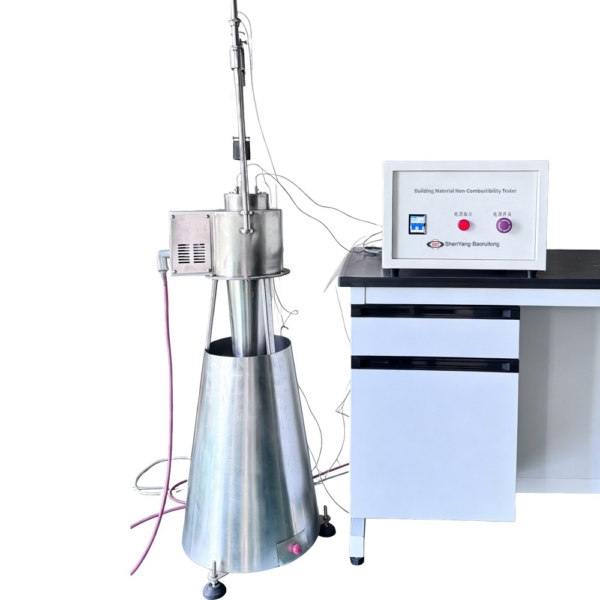
JBR20 non-combustibility furnace used for EN ISO 1182 testing behind Euroclass A1 and A2.
One boundary matters when writing specifications. ISO 1182 measures whether a material burns — it says nothing about how long a wall survives a fire. Reaction to fire (ISO 1182, EN 13501-1) and fire resistance (EN 13501-2, ISO 834 furnaces) are different properties tested in different apparatus, and conflating them is the most expensive mistake a buyer can make in procurement documents.
One boundary matters when writing specifications. ISO 1182 measures whether a material burns — it says nothing about how long a wall survives a fire. Reaction to fire (ISO 1182, EN 13501-1) and fire resistance (EN 13501-2, ISO 834 furnaces) are different properties tested in different apparatus, and conflating them is the most expensive mistake a buyer can make in procurement documents. The same discipline applies to the phrase “non-combustible” itself: in the Euroclass system it is a verdict assembled from two test reports, and a datasheet that uses the word without naming the standard, the edition and the class is describing an aspiration, not a result. The discipline costs one line in a specification and saves weeks in a tender dispute.
The Furnace and Apparatus, Part by Part
The apparatus is deliberately simple, and every component is specified in the standard [1]3. The classic geometry — a vertical refractory tube with a conical airflow stabiliser beneath and a draught shield above — is confirmed across independent laboratory descriptions of the rig 6:
| Component | Key requirements |
|---|---|
| Furnace tube | Refractory tube, height (150±1) mm, inner diameter (75±1) mm, wall thickness (10±1) mm, alumina-based refractory of density (2800±300) kg/m³ |
| Heating | Electrical, stable at 750 °C; conical airflow stabiliser beneath the tube; draught shield above |
| Furnace thermocouples | Furnace wall thermocouple plus a second furnace thermocouple introduced in the 2020 edition; readings averaged to reduce fluctuation |
| Specimen thermocouples | Contactable surface thermocouple and centre thermocouple on the specimen |
| Specimen holder | Stainless steel stand with wire grid, on an insertion device |
| Balance | Reads to 0.01 g (mass loss judged against ≤ 50 % limit) |
| Timer / data capture | Records temperatures for the full run; flaming timed by observer or video |
The 2020 edition’s most visible change is that second furnace thermocouple: the two furnace temperature signals are averaged, which suppresses the local fluctuations that single-thermocouple furnaces showed, and furnace stability and calibration procedures were tightened accordingly [1][3]. Laboratories running older 2010-edition furnaces should expect classification bodies to ask about the upgrade path.
Specimens: Preparation, Number and Conditioning
Specimens are cylinders of 45 mm diameter × 50 mm height [1][3]. Preparation differs by product type:
| Product type | Specimen rule |
|---|---|
| Rigid homogeneous | Minimum 8 cylinders cut to 45 × 50 mm; layers of homogeneous composition may be stacked |
| Thickness < 50 mm | Layers stacked to reach 50 mm total height |
| Non-homogeneous products | Each substantial component (≥ 1.0 mm layer thickness or ≥ 1.0 kg/m²) prepared and tested separately |
| Mineral wool-like | Cut from representative pieces ≥ 300 × 300 mm × 50 mm thick |
| Castable products (gypsum etc.) | Poured into split moulds of ~45 mm inner diameter, released after curing |
| Loose fill | Contained per the standard’s guidance before testing |
Five specimens are run per product and reported as means [2][3]. Conditioning follows the standard state procedures referenced in the document set (EN 13238 in the European route): specimens are dried to constant mass, then held at (23±2) °C and (50±5) % relative humidity before testing [2]. Moisture behaviour matters because hydrated products such as gypsum release steam in the furnace — part of the measured mass change — which is exactly why conditioning discipline is a calibration-level concern, not a formality.
The Procedure, Minute by Minute
Stabilisation and the Run
The furnace is preheated and stabilised at approximately 750 °C — the standard’s stability check requires the furnace temperature to hold within a narrow drift band before a run may start [1][3]. Then:
Stabilisation and the Run
- Weigh the conditioned specimen; fit surface and centre thermocouples; place it in the holder.
- Insert the specimen into the furnace within the standard’s insertion time and start the clock.
- Record furnace, surface and centre temperatures continuously for the 30-minute exposure — extended where equilibrium has not been reached.
- Observe and time any sustained flaming (2020 edition: flaming persisting 5 seconds or longer counts as sustained [2][3]).
- Remove the specimen, cool it in a desiccator, collect all debris, and weigh to 0.01 g.
- Repeat for the remaining specimens; compute means per the standard’s formulas in Clause 8.
Furnace Qualification Between Tests
What happens between specimen runs separates a classification-grade furnace from a hobbyist tube oven. The standard requires the operator to verify furnace stability before every series: with the specimen absent, the wall thermocouple reading must hold within the drift limits of the standard for the stabilisation window, and the calibration routine — performed with the specimen holder and thermocouples in their measuring positions — must be on record with a defined repeat interval [1][3][6]. The calibration checks the furnace’s own temperature curve against the standard’s reference values, not merely that the controller displays 750 °C; a furnace can be perfectly stable at the wrong temperature profile and still produce invalid data. Accredited laboratories treat this qualification record as a controlled document, because a classification body reviewing an A1/A2 file will ask when the furnace was last qualified and against which edition. When shortlisting suppliers, ask for the qualification procedure in writing: “factory-calibrated” is not an answer that survives an audit.

The A1/A2 Criteria — the Numbers That Decide
The Limits, Applied to the Means
Classification bodies apply EN 13501-1 criteria to the means of the five runs [2][3]:
| Criterion (mean of 5) | Class A1 | Class A2 |
|---|---|---|
| Furnace temperature rise | ≤ 30 °C | ≤ 50 °C |
| Sustained flaming | none | ≤ 20 s |
| Mass loss | ≤ 50 % | ≤ 50 % |
Two readings of this table prevent most specification errors. First, the ISO 1182 result alone is not a class — A1 additionally requires the EN ISO 1716 gross heat of combustion (PCS ≤ 2.0 MJ/kg for homogeneous products), and A2 either the relaxed furnace route or PCS ≤ 3.0 MJ/kg, plus the SBI test [2]. Second, “no sustained flaming” for A1 is absolute: even a brief flare that persists 5 seconds or longer breaks the criterion, which is why margin-heavy products sit more comfortably at A2.
The arithmetic is unforgiving in one direction only: mass loss has no lower relevance limit. A product that loses 50 % of its mass and stays silent still fails A1’s mass criterion at the boundary — classification is judged on the numbers, not on how benign the mechanism sounds. Suppliers quoting “passes ISO 1182” without stating ΔT, Δm and t_f means for all five specimens are quoting an incomplete result. And because the criteria apply to means, a single outlier specimen can drag a borderline product across the line in either direction — which is why laboratories keep spare specimens, condition them cleanly, and record every observation.
What This Means for the EN 13501-1 Hub
The furnace and the calorimeter produce numbers; EN 13501-1 turns them into the class string a specifier reads. How those classes fit together — which test decides which letter, and where the SBI takes over — is set out in our EN 13501-1 Euroclass guide, and the two articles are designed to be read as a pair: that one answers “which class”, this one answers “how the furnace evidence is produced”.
ISO 1182 and ASTM E136: Similar Question, Different Answer Sheet
Buyers comparing laboratories across markets often meet ASTM E136 beside ISO 1182. Both tests put a small specimen into a 750 °C furnace to answer “does this material burn”, but the paperwork differs enough that one report cannot stand in for the other:
| Aspect | ISO 1182:2020 | ASTM E136 (as commonly run) |
|---|---|---|
| Specimen orientation | Cylinder on a holder, thermocouples on surface and centre | Vertical specimen on a stand |
| Result logic | Three measured criteria → feeds A1/A2 classes | Pass/fail against criteria incl. specimen temperature limit |
| Role in classification | Input to EN 13501-1 classes | Material deemed non-combustible in its own right |
| Typical use | EU/CPR, marine FTP Code, GB/T 5464 | US specifications, other ASTM framed systems |
The safe specification language is therefore “non-combustibility tested to ISO 1182” or “to ASTM E136” — never “non-combustible” as a free-floating adjective, and never one standard’s report cited against the other’s requirement [2][6].
IMO FTP Code Part 1: The Same Furnace, Different Judges
Where IMO Is Stricter
Marine approval runs ISO 1182 under IMO FTP Code Part 1, and the acceptance criteria are stricter than the construction route [4]:
| Criterion (mean) | EN 13501-1 A1 | IMO FTP Part 1 non-combustible |
|---|---|---|
| Furnace thermocouple temperature rise | ≤ 30 °C | ≤ 30 °C |
| Specimen surface thermocouple rise | not a stated criterion | ≤ 30 °C |
| Sustained flaming | none | ≤ 10 s |
| Mass loss | ≤ 50 % | ≤ 50 % |
Two differences decide real cases: IMO additionally limits the surface thermocouple rise to 30 °C and allows at most 10 seconds of sustained flaming [4]. A construction-oriented report showing, say, 15 seconds of flaming cannot be transferred to a marine approval file. Laboratories serving shipbuilding clients therefore run the IMO criteria set explicitly, and our furnace documentation records surface temperature as a first-class result rather than an optional extra.
GB/T 5464-2026: China Adopts the 2020 Edition
China’s national non-combustibility test method, GB/T 5464, was revised with effect from 1 October 2026 [5]. GB/T 5464-2026 (published 31 March 2026) is a modification of ISO 1182:2020 and fully replaces GB/T 5464-2010, which had been in service for sixteen years [5]. For manufacturers the practical consequences are concrete:
| Item | GB/T 5464-2010 (based on ISO 1182:2010) | GB/T 5464-2026 (mod. ISO 1182:2020) |
|---|---|---|
| Edition basis | 2010 | 2020, incl. second furnace thermocouple |
| Status since 2026-10-01 | superseded | current for Chinese market A-class claims |
| Who must act | — | Laboratories and manufacturers serving GB 8624 A-class declarations |
Reports citing GB/T 5464-2010 issued after 1 October 2026 no longer demonstrate conformity for new Chinese certifications. Exporters who test in China and declare in Europe should confirm their laboratory has migrated furnaces and reports to the 2020-aligned method, because the GB version and the EN version of the furnace now share the same international edition for the first time since 2010 [3][5].
Equipment Choices: What Makes a Compliant Furnace
Procurement for an ISO 1182 furnace is a compliance exercise, not a temperature-controller purchase. Five items decide whether the instrument can produce classification-grade data:
| Item | What to require |
|---|---|
| Furnace tube and stabiliser | Dimensions and refractory density per ISO 1182 Annex B; conical airflow stabiliser included |
| Thermocouple set | Wall + centre + surface, dual furnace thermocouples for the 2020 edition, IEC-tolerance types |
| Control and stability | 750 °C stabilisation within the standard’s drift limits; voltage fluctuation compensation |
| Data system | Continuous multi-channel logging (≥ 1 Hz), automatic ΔT calculation per Clause 8 formulas |
| Documentation | Calibration procedures, furnace-qualification record, traceability for classification reports |
A furnace that cannot show its calibration and stability records will be challenged by any notified body reviewing an A1/A2 classification file. Our non-combustibility test apparatus ships with the dual-thermocouple 2020-edition configuration, and pairs naturally with the oxygen bomb calorimeter that EN ISO 1716 requires — the two instruments together cover the full A1/A2 evidence chain for both the EN and GB routes.

Common Mistakes With ISO 1182
| Mistake | Consequence | What to do |
|---|---|---|
| Treating “passed ISO 1182” as Class A1 | A1 also needs EN ISO 1716 PCS limits | Ask for both reports and the class string |
| Using a 2010-edition furnace for a 2020-edition classification | Classification bodies question the data | Confirm dual furnace thermocouples and calibration record |
| Reusing a construction report for IMO approval | Marine file rejected (flaming ≤ 10 s, surface ΔT) | Run the IMO criteria set explicitly |
| Skipping conditioning discipline | Steam release distorts ΔT and Δm | Follow EN 13238 / standard conditioning exactly |
| Reading ΔT from one thermocouple only | 2020 edition averages two furnace signals | Check the report states the averaged furnace rise |
Frequently Asked Questions
What is the current version of ISO 1182?
The current edition is ISO 1182:2020, the sixth edition, published on 3 June 2020 by ISO/TC 92/SC 1. It replaced ISO 1182:2010, and the European adoption EN ISO 1182:2020 superseded EN ISO 1182:2010. The most visible 2020 change is a second furnace thermocouple whose readings are averaged with the first to reduce fluctuation, plus tightened calibration and stability procedures.
What are the pass criteria for Class A1 in the ISO 1182 test?
Under EN 13501-1, Class A1 requires the mean furnace temperature rise not to exceed 30 °C, no sustained flaming on any specimen, and mean mass loss not exceeding 50 %, with the results taken from five parallel runs. A1 additionally requires the gross heat of combustion from EN ISO 1716 to be at most 2.0 MJ/kg for homogeneous products. The ISO 1182 result alone never constitutes a class.
How many specimens are tested in ISO 1182?
Five specimens are tested and the criteria are applied to their means, though a minimum of eight cylindrical samples (45 × 50 mm) should be prepared to allow for spares and repeat runs. Mineral wool-like products are cut from larger representative pieces, and castable products are poured into split moulds of about 45 mm inner diameter.
What changed between ISO 1182:2010 and ISO 1182:2020?
The 2020 edition added a second furnace thermocouple, with the two furnace temperature signals averaged to suppress local fluctuations, and tightened furnace calibration and stability procedures. The sustained-flaming definition of 5 seconds or longer is used for reporting, and the precision information in Annex A was updated. Furnace hardware from the 2010 era generally needs a thermocouple upgrade and recalibration to satisfy 2020-edition classification files.
Is ISO 1182 the same as ASTM E136?
No. Both are non-combustibility tests, but ASTM E136 runs a vertically mounted specimen in a 750 °C furnace with different criteria (including a specimen temperature limit) and a pass/fail logic rather than the A1/A2 criteria structure. Results are broadly similar in principle for mineral materials but are not interchangeable in specifications: a report under one standard does not demonstrate conformity under the other.
Why did China revise GB/T 5464 in 2026?
GB/T 5464-2026, published 31 March 2026 and in force from 1 October 2026, is a modification of ISO 1182:2020 and fully replaces GB/T 5464-2010. The revision aligns the Chinese method with the international 2020 edition, including the dual furnace thermocouple arrangement, so that A-class material declarations under GB 8624 rest on the same furnace technology used in European EN ISO 1182:2020 classifications.
What equipment does a laboratory need for ISO 1182 and A1/A2 work?
The core chain is two instruments: a non-combustibility furnace built to ISO 1182 with dual furnace thermocouples, and an oxygen bomb calorimeter for EN ISO 1716 gross heat of combustion. Laboratories also serving the SBI-based classes later add the EN 13823 corner rig and the EN ISO 11925-2 small flame apparatus, but A1 and A2 evidence is complete with the furnace and calorimeter pair when the classification criteria of EN 13501-1 are applied.
Conclusion: A Short Buying Checklist
- Buy the furnace for the edition you will be audited against — dual furnace thermocouples for ISO 1182:2020, and say so in the purchase order.
- Pair it with the calorimeter: no A1 or A2 classification exists on furnace data alone.
- Decide your regulatory regimes up front — EN 13501-1, IMO FTP Part 1 and GB/T 5464-2026 share the furnace but not the criteria sets.
- Ask any supplier for the classification-grade evidence chain: calibration records, stability demonstration and the five-specimen mean formulas.
If you are equipping a laboratory for ISO 1182 and the A1/A2 evidence chain, BRT builds the non-combustibility furnace, the oxygen bomb calorimeter and the full EN 13501-1 test suite as single instruments or integrated laboratories. Tell us your target classes and markets, and our engineers will configure the equipment set to match the audits you expect to face.
About BRT: Shenyang Baoruitong Automation Equipment Co., Ltd. (BRT) manufactures fire and flammability testing equipment — including non-combustibility furnaces, oxygen bomb calorimeters and complete reaction-to-fire laboratories — for customers in China and export markets. This guide was prepared by the BRT engineering team from the published editions of the standards cited below.