What does s1, d0 mean in EN 13501-1?
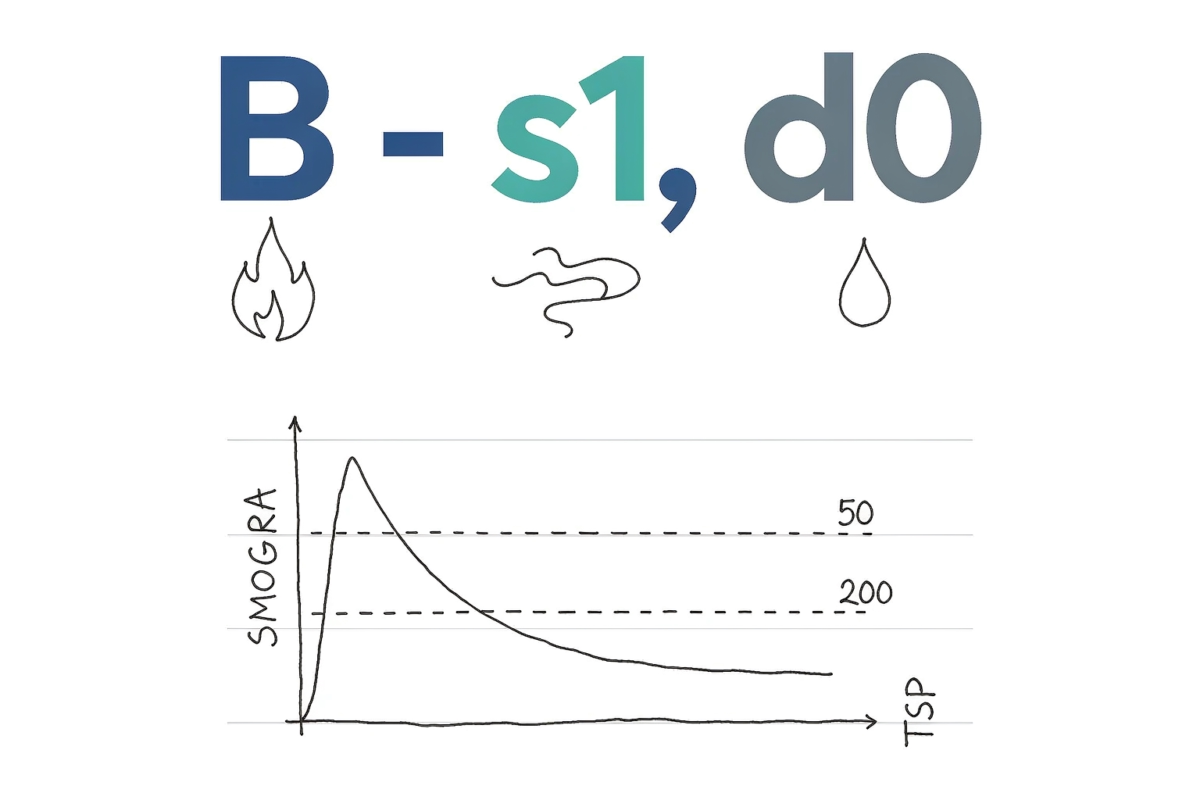
The string s1,d0 is the “additional classification” attached to Euroclasses A2, B, C and D: s1 rates smoke production and d0 rates flaming droplets, both measured during the same SBI test (EN 13823) that decides the main letter. A product declared B-s1,d0 has very limited contribution to fire (B), low smoke growth (s1: SMOGRA ≤ 30 m²/s² and total smoke production ≤ 50 m² over 600 s), and produced no flaming droplets in the 600-second SBI run. A1 and F never carry additional classes; E carries only a d2 code at most 12.
What do the smoke classes s1, s2 and s3 measure?
They classify how fast and how much smoke the product releases during the SBI test, using two numbers: SMOGRA (the smoke growth rate index, in m²/s²) and TSP600s (total smoke production over 600 seconds, in m²). The thresholds, applied to the mean of the SBI runs [1][2]:
| Smoke class | Criteria (from the SBI test) |
|---|---|
| s1 | SMOGRA ≤ 30 m²/s² and TSP600s ≤ 50 m² |
| s2 | SMOGRA ≤ 180 m²/s² and TSP600s ≤ 200 m² |
| s3 | Not s1 or s2 |
The distance between s1 and s2 is a factor of six on smoke growth and four on total smoke — they are not adjacent grades on a smooth scale. In a corridor or any single-escape-route layout, the s class decides whether the escape route stays visible for the time the fire strategy assumes, which is why specifiers write s1 into tall-building and transit requirements even when the main letter is already fixed [2].
What do the droplet classes d0, d1 and d2 mean?
They classify whether the product drops burning particles during the 600-second SBI run, and for how long those particles keep flaming [1][2]:
| Droplet class | Criteria (from the SBI test) |
|---|---|
| d0 | No flaming droplets or particles within 600 s |
| d1 | Flaming droplets/particles occur, but none persisting longer than 10 s |
| d2 | Not d0 or d1 — i.e. droplets persisting longer than 10 s occurred |
One extra rule closes a loophole: ignition of the filter paper in the small-flame test (EN ISO 11925-2) results in a d2 classification regardless of the SBI result [2]. Droplets matter most where one material sits above another — a ceiling over an escape route, a facade over a pavement — because a dripping product turns one fire into several fires below it [2].
Which Euroclasses carry s and d codes?
Classes A2, B, C and D carry both smoke and droplet codes; class E carries only d2; classes A1 and F carry no additional classes at all [1][2]:
| Main class | Smoke code | Droplet code | Example full string |
|---|---|---|---|
| A1 | — | — | A1 |
| A2 | s1 / s2 / s3 | d0 / d1 / d2 | A2-s1,d0 |
| B | s1 / s2 / s3 | d0 / d1 / d2 | B-s2,d1 |
| C | s1 / s2 / s3 | d0 / d1 / d2 | C-s1,d0 |
| D | s1 / s2 / s3 | d0 / d1 / d2 | D-s2,d0 |
| E | — | d2 only | E-d2 |
| F | — | — | F |
Floor coverings take smoke codes (s1, s2) but never droplet codes, because a floor cannot drip onto the room below; their strings read, for example, Bfl-s1 [2]. For A2 and B, the same SBI run that decides the main letter also delivers s and d — the additional classes are not extra tests, they are extra read-outs of the same 20 minutes [1].
Why is “Class B” alone not a classification?
Because the main letter covers only the contribution to fire — roughly a third of the declared performance — and the s and d codes cover the smoke and dripping behaviour that often decide a specification. A quotation reading “Class B” could be B-s1,d0 (low smoke, no droplets) or B-s3,d2 (heavy smoke, persistent droplets): both are Class B, and they are not interchangeable in any corridor, stairwell or facade. Ask for the full string in writing before the order is placed, not after the container is loaded [2]. Where a tender says “B or better”, remember that the jump from A2 to B also crosses from the non-combustibility test regime into the combustible regime — “or better” is a substitution clause, not a grade step [2].
How is s1,d0 measured in practice?
Both codes are read from the single burning item (SBI) run per EN 13823: two panels form a corner, a 30 kW burner burns against the joint for 20 minutes, and the rig logs smoke obscuration and droplet events alongside heat release [1][2]. SMOGRA is computed from the light-attenuation signal in the exhaust duct; droplets are observed and timed at the specimen. Because one run supplies main class, smoke class and droplet class together, a classification campaign that plans its SBI capacity well delivers the complete string without duplicate testing — which is how our single burning item test system is configured: smoke measurement and droplet observation are part of the standard package, not optional extras. The full procedure is in our SBI test step-by-step guide, and how s/d fit into the whole ladder is in the EN 13501-1 Euroclass guide.

Which buildings actually require s1 and d0?
England wrote the most cited requirement into law: Regulation 7(2) of the Building Regulations 2010 (as amended by SI 2018/1230) requires materials in the external walls of relevant buildings 18 metres or taller to be A2-s1,d0 or A1 3. Outside England, the string travels with specifiers rather than law: transit interior specifications, airport projects and Middle-East high-rise codes commonly demand A2-s1,d0 or B-s1,d0 by name, borrowing the English requirement as a de facto quality bar [2]. Two reading habits prevent most mistakes: check whether the s1,d0 in your tender is legally required or copied from another document, and remember that exempted components (sealants, gaskets, fire-stopping) are listed in the regulation — the string applies to the wall materials, not to every penetration product [3].

Does an A2 product always score s1 and d0?
No — and this is the most common misreading of datasheets. The main class and the additional classes are independent: A2 requires the furnace/calorimeter route plus the SBI thresholds, but the s and d codes that come out of that same SBI run can be any combination. A mineral-faced panel with an organic binder can be A2-s2,d0; a foam-cored composite can reach A2-s3,d1. Even A2-s3,d2 is a valid, declarable string. What the market does with that freedom is the real filter: UK Regulation 7(2) demands A2-s1,d0 specifically, so an A2 product with worse sub-classes still fails the wall-material requirement despite carrying the right main letter [2][3]. When a customer says “A2 required”, ask which full string the specification names before promising compliance.
How do you specify smoke and droplets on a purchase order?
Write the complete string, name the edition, and ask for the classification report — three lines that take a minute and prevent the two most common disputes. A conforming PO line reads, for example: “Reaction to fire classification EN 13501-1:2018, B-s1,d0, classification report to be supplied with the delivery.” Three habits make the line effective: the full string (not “Class B”) covers smoke and droplets in the same clause; naming the 2018 edition blocks old 2007-edition certificates from re-entering the file; and demanding the classification report — not a summary certificate — gives you the thickness, substrate and mounting the class was earned on. The SBI run behind that report is exactly what our single burning item test system produces for laboratories that verify supplier claims in house.
Frequently Asked Questions
Can a product get s1 without d0?
Yes. The smoke and droplet codes are independent read-outs of the same SBI run: a product can score s1 (low smoke) and d1 (droplets that self-extinguish within 10 seconds) at the same time, giving B-s1,d1 for example. Only when the droplet criteria fail entirely does d2 replace d0/d1.
Why does class E only get a d2 code?
Class E is decided by the small-flame test alone, which measures ignitability — not smoke. There is no smoke data to classify, so no s code exists for E. The droplet code exists in one form only: if the filter paper beneath the specimen ignites in the small-flame test, the product is d2; otherwise it is simply declared E without a droplet suffix.
Do floor coverings have droplet classes?
No. Flooring classes (A1fl to Ffl) take only smoke codes, and only s1 or s2 — a floor cannot drop flaming particles onto the space below, so the d scale does not apply. A flooring string therefore reads Bfl-s1 or Cfl-s2, never with a d component.
What is the difference between s2 and s3?
s2 is a pass: SMOGRA at most 180 m²/s² and total smoke production at most 200 m² over 600 s. s3 is everything else — the product produced more smoke than the s2 limits allow. There is no “worst value” scale below s2; once the s2 thresholds are exceeded, the product is s3 and the report stops there.
Does the s/d classification require extra tests?
No. For classes A2 to D the additional classes come from the same SBI run that decides the main letter — they are additional read-outs, not additional tests. The only cross-test interaction is the small-flame filter-paper rule, which can turn a d0/d1 result into d2.
Conclusion: Read the Whole String
- s codes = smoke growth (SMOGRA) + total smoke (TSP600s); d codes = flaming droplets in the SBI run.
- A2–D carry both; E carries only d2; A1 and F carry none; floorings carry s only.
- s1 vs s2 is a factor of six on smoke growth — treat the sub-class as a specification of its own.
- Quote the full string (e.g. B-s1,d0) in writing, and check whether your tender’s s1,d0 is a legal requirement or a borrowed habit.
BRT builds the SBI systems that produce these strings — smoke measurement and droplet observation included as standard — alongside the full EN 13501-1 instrument suite. Ask us about a complete classification setup and we will match the configuration to the classes your customers specify.
About BRT: Shenyang Baoruitong Automation Equipment Co., Ltd. (BRT) manufactures fire and flammability testing equipment — including SBI systems, non-combustibility furnaces and oxygen bomb calorimeters — for laboratories in China and export markets. This guide was prepared by the BRT engineering team from the published editions of the standards cited below.