

What Heat Release and Oxygen Index Tell You
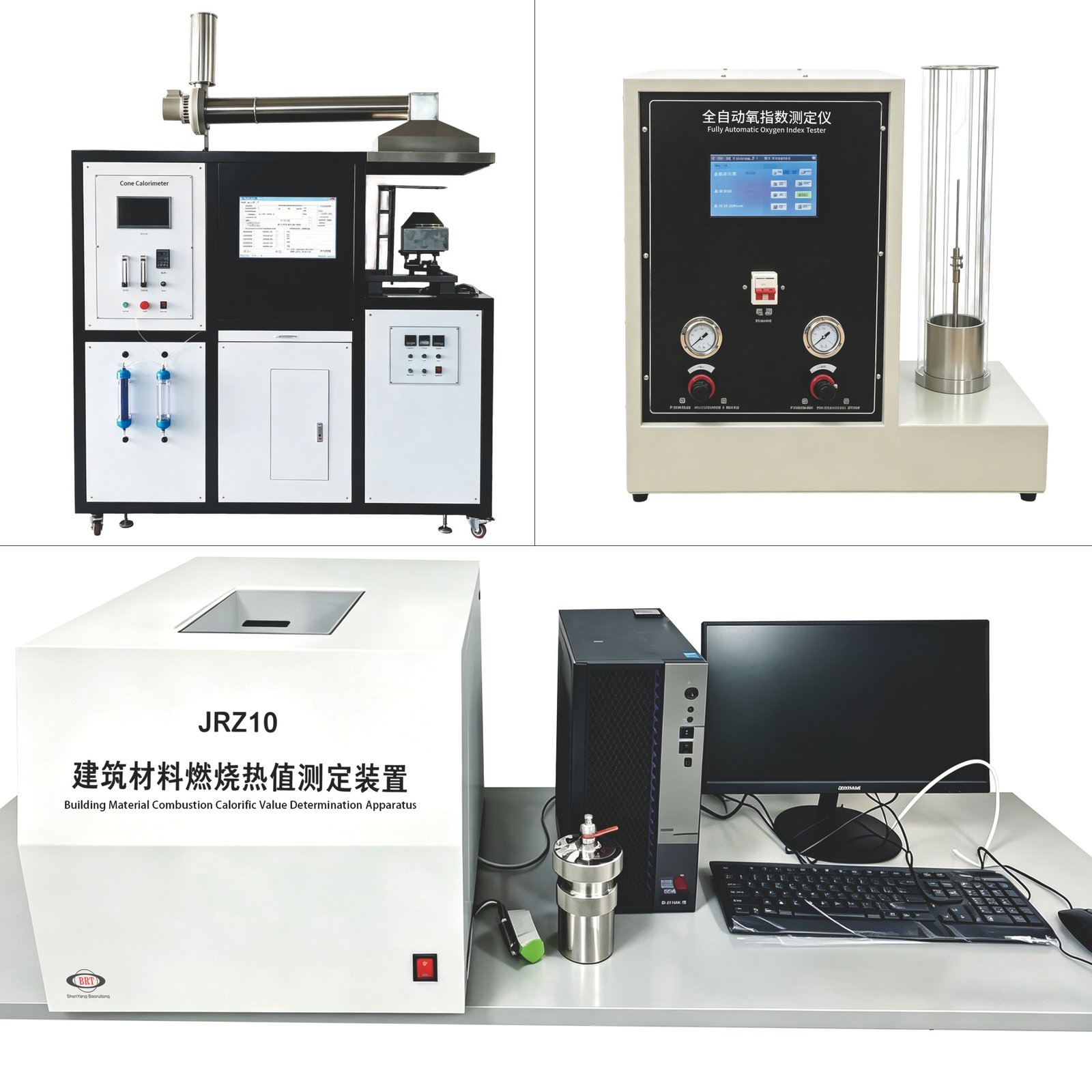
The four instruments answer three different questions, and they are not interchangeable. The oxygen index is a ranking tool: cheap, fast, and repeatable enough to compare a hundred formulations. The cone calorimeter is a characterisation tool: one run produces the ignition behaviour, the heat release curve and the smoke data. The bomb calorimeter is an evidence tool: it produces the PCS figure that EN 13501-1 classification reports for A1 and A2 actually cite.
| Instrument | Model | Standard | What it decides |
|---|---|---|---|
| Cone calorimeter | ZXLR | ISO 5660-1 / -2, ASTM E1354 | Ignition time, pHRR, THR, effective heat of combustion, smoke — development and research data |
| Oxygen bomb calorimeter | JRZ10 | ISO 1716 (ASTM D5865 family) | Gross heat of combustion (PCS) — the A1/A2 evidence in an EN 13501-1 classification |
| LOI tester, manual / semi-automatic | JYZS-10 | ISO 4589-1/-2, BS 2782-1 | High-volume flame-retardant screening at the lowest cost per result |
| Intelligent LOI tester, fully automatic | JYZS-20 | ASTM D2863 (ISO 4589-2 equivalent procedure) | Touchscreen control, automatic gas blending, logged results |
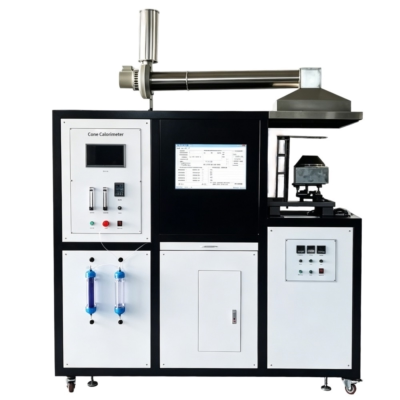
The cone calorimeter is the reference bench-scale instrument for heat release. A 100 × 100 mm specimen sits on a load cell beneath a radiant cone heater; a spark igniter fires the evolved gases, and the exhaust duct carries everything the specimen produces past an oxygen analyser, a CO2 analyser and a smoke photometer.
How the test runs
Heat release is computed from oxygen consumption using the Huggett relationship — 13.1 MJ per kilogram of oxygen consumed — which makes the measurement traceable to gas analysis rather than to any estimate about the material. The cone flux is set to match the scenario of interest: 25, 50 and 75 kW/m² are the common levels, and the ZXLR supports horizontal and vertical specimen orientations. The load cell records mass loss continuously, so the effective heat of combustion falls out of the same run. A typical campaign conditions the specimens, runs three replicates per formulation, and reads the averaged curves.
| Result | What it tells you |
|---|---|
| Time to ignition | How long the material resists a given radiant flux — the first screening number |
| pHRR (peak heat release rate) | The worst second of the fire — the figure most specifications quote first |
| THR (total heat release) | How much fuel the specimen actually delivered over the run |
| Effective heat of combustion | Energy per unit mass burned — separates “less fuel” from “slower burning” |
| Smoke production rate (ISO 5660-2 option) | Light attenuation in the same duct, same run, no second instrument |
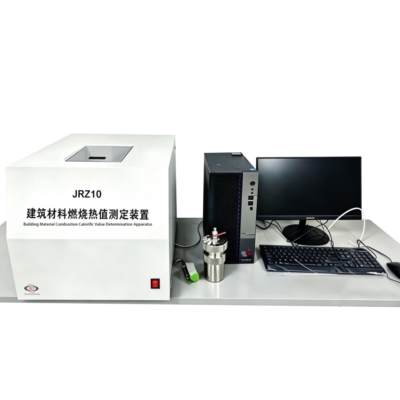
Where the cone measures how a fire develops, the bomb calorimeter measures how much energy there is in total. A ground, dried specimen of about half a gram burns in a stainless-steel bomb filled with oxygen at 3.0 MPa, and the temperature rise of the surrounding water bath — corrected for cooling, nitric-acid formation and fuse-wire energy — gives the gross heat of combustion, the PCS.
How the test runs
The JRZ10 runs the full correction chain automatically and carries the benzoic-acid calibration workflow in its software, because a PCS number without a traceable calibration will not survive an accreditation assessment. Homogeneous products are ground and pelletled directly; layered products are separated into substantial and non-substantial components, each measured on its own, with the thin layers limited in MJ/m² rather than MJ/kg.
| Parameter | A1 | A2 |
|---|---|---|
| PCS — homogeneous products and substantial components | ≤ 2.0 MJ/kg | ≤ 3.0 MJ/kg |
| PCS — external non-substantial layers | ≤ 2.0 MJ/m² | ≤ 4.0 MJ/m² |
| PCS — internal non-substantial layers | ≤ 1.4 MJ/m² | ≤ 4.0 MJ/m² |
| Product as a whole | — | ≤ 3.0 MJ/kg |
| A1 and A2 also need the ISO 1182 furnace result; A2 additionally needs the SBI (EN 13823). | ||
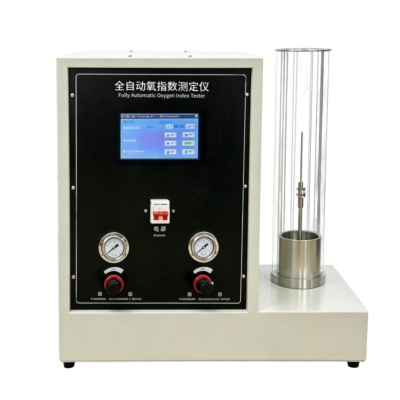
The oxygen index inverts the question a fire test usually asks. Instead of applying a flame and watching what happens, the instrument holds a small vertical specimen burning in a glass chimney while you dial the oxygen concentration in the nitrogen stream — and find the lowest concentration at which the specimen just sustains combustion. Air is 21 % oxygen, so a material with an LOI below that burns readily in open air; the higher the index, the more the material tends to extinguish on its own.
How the test runs
A specimen is clamped vertically in the chimney, ignited at its top edge, and observed against two criteria: whether flaming continues past 180 seconds, and whether the burned length passes the 50 mm mark. If the specimen passes at a given concentration, the oxygen fraction is lowered and the run repeats; the LOI is bracketed across a series of runs. The current edition of the ISO method is ISO 4589-2:2017, and the ASTM route — ASTM D2863 — is equivalent wherever the oxygen concentration is measured directly rather than inferred from flow rates.
| Parameter | Value |
|---|---|
| Pass criterion | Flaming stops within 180 s, or burned length does not exceed 50 mm |
| Conditioning | 23 ± 2 °C and 50 ± 5 % RH, per ISO 291 — moisture moves the result |
| Result | LOI in volume % — the bracketed minimum oxygen concentration |
Calibration and Operation Essentials
All four instruments live or die by their measurement chain, and that is where an ISO 17025 assessment looks first.
Keep calibration certificates traceable to national standards and store the raw channels, not just the calculated results, so every figure in a report can be walked back to its run
Customised Hardware and Software, Delivered as One System
No two laboratories have the same bench, the same gas supply or the same reporting chain — so the ZXLR, JRZ10 and both JYZS models are built to order. Extraction interfaces, gas train routing, specimen handling and the data platform are configured around your workflow, with result templates and data export formatted for your reporting. Layout planning, installation, calibration support and operator training are delivered as a single commissioning programme.

