


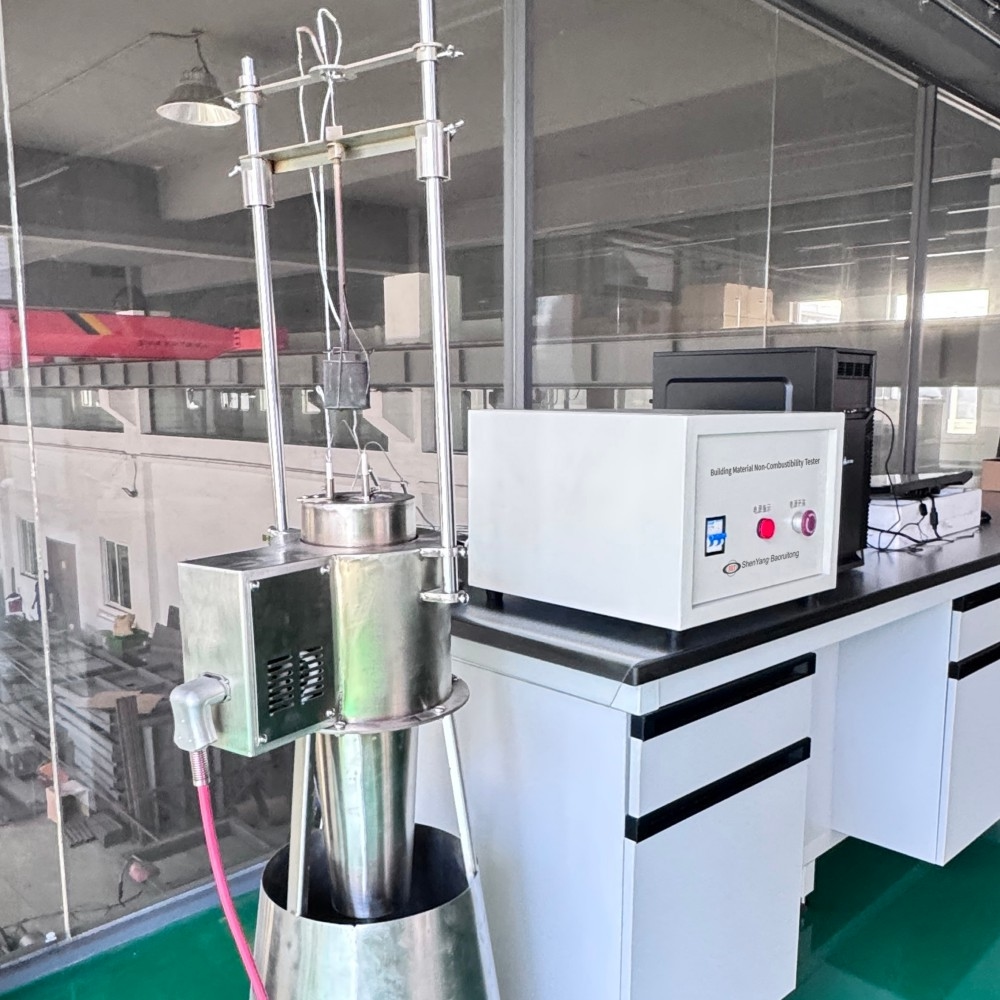
Non-Combustibility Test Apparatus
The JBR20 Non-Combustibility Test Apparatus is a high-precision, computer-controlled laboratory system engineered to evaluate whether homogeneous and non-homogeneous building products contribute directly to fire growth when exposed to high-temperature thermal attack.
Main Functions:
- High-Precision Furnace Temperature & Power Control
- Multi-Point Thermocouple Diagnostics
- Automated Data Acquisition & Result Calculation
Testing Standards:
- ISO 1182:2020
- EN 13501-1 (Euroclass A1/A2 classification testing)
- ASTM E2652
- IMO FTP Code Part 1
- GB/T 5464-2026
- GB 8624-2025
Pre-Shipment & Testing
Factory Acceptance Test (FAT) & Pre-Shipment Inspection
Real Machine Testing Videos & Test Reports Available
Warranty & Tech Support
1-Year Warranty & Lifetime Remote Technical Support
Complete English Manuals & Video Tutorials Provided
Certification & Customization
Third-Party Calibration Certificates Available
Full OEM & ODM Customization for Specific Lab Needs
Global Export & Logistics
Worldwide Express & Sea/Air Freight Shipping
Complete International Export Documentation Provided
What Is the Non-Combustibility Test?
The Non-Combustibility Test is a critical, standardized laboratory procedure used to determine whether homogeneous building products and the main components of non-homogeneous building products contribute directly to fire growth. By subjecting a test specimen to a high-temperature furnace (typically stabilized at 750 °C), the test evaluates flame occurrence, temperature rise inside the furnace and within the specimen, and mass loss to determine Euroclass (EN 13501-1 Reaction to Fire Classification) A1/A2 or GB 8624 Class A non-combustible performance ratings.
What Is the JBR20 Non-Combustibility Test Apparatus?
The JBR20 Non-Combustibility Test Apparatus is a high-precision, computer-controlled laboratory system engineered in strict compliance with ISO 1182:2020, IMO FTP Code Part 1, ASTM E2652, GB/T 5464-2026, and GB 8624-2025. Featuring an all-stainless-steel furnace body, dual-loop temperature/power control, and advanced software-driven data acquisition, the JBR20 delivers rapid heating, highly accurate temperature regulation, and automated test result calculations for strict product compliance and quality control.
-

- JBR20 Non-Combustibility Test Apparatus
-
- A run in progress: the specimen sits in the 750 °C furnace while three temperature channels are logged.
-
- JBR20 non-combustibility furnace: the 2020 edition adds a second furnace thermocouple.
Applicable Materials
The JBR20 Non-Combustibility Tester is designed for evaluating a wide range of building and construction materials, including:
- Homogeneous Building Products: Mineral wool, rock wool, glass wool, concrete, silicate boards, gypsum, mortar, and clay bricks.
- Components of Non-Homogeneous Products: Core layers, structural facings, and primary inorganic components of composite panels.
- Insulation Materials: High-density inorganic thermal insulation materials and fireproof boards.
Main Functions and Modules
- All-Stainless-Steel Heating Furnace: Constructed with a high-durability stainless steel body, standard furnace tube, and an integrated height-positioning block for rapid and accurate specimen holder placement.
- Advanced 4-Thermocouple System: Equipped with Class 1 accuracy thermocouples, including dual furnace-temperature thermocouples (compliant with ISO 1182:2020), 1 specimen-surface thermocouple, and 1 specimen-center thermocouple.
- Dual-Loop Temperature & Power Control: Features automatic switching from constant-temperature to constant-power mode without manual intervention, maintaining power fluctuations within 1% and empty-furnace temperature deviations within 2 °C.
- Automatic Power Compensation & Soft-Start: Advanced power-compensation technology dynamically adjusts heating power when voltage fluctuates, while the soft-start routine regulates furnace temperature in stages to extend heating core lifespan.
- Intelligent Software & Data Logging: High-frequency sampling software automatically detects flame duration, records furnace/specimen temperature curves, and logs results for seamless query and data export.
Technical Parameters
| Parameter | Technical Specification |
|---|---|
| Applicable Standards | ISO 1182:2020, IMO FTP Code Part 1, ASTM E2652, GB/T 5464-2026, GB 8624-2025, GB/T 40238-2021 |
| Heating Voltage & Power | 0–100 V Heating Voltage; 0–1500 W Furnace Power |
| Heating Temperature Range | Ambient Temperature to 1000 °C |
| Temperature Measurement Accuracy | Class 1 Accuracy (±1.5 °C or 0.4% of measured value) |
| Thermocouples Configuration | 4 Thermocouples (Type K, Wire Ø0.3 mm, Outer Ø1.5 mm); 2 Furnace, 1 Surface, 1 Center |
| Furnace Tube Dimensions | Height: 150 ± 1 mm; Inner Diameter: 75 ± 1 mm; Wall Thickness: 10 ± 1 mm |
| Specimen Dimensions | Cylindrical: Ø45 mm × 50 mm |
| Stabilization Time | 40–60 minutes (from room temperature to stable operation at 750 °C) |
| Power Supply & Environment | Single-phase AC 220 V ± 5%, 50 Hz; Operating Temp: 23 ± 5 °C, Humidity: 50 ± 20% |
Important Notes
- Laboratory Environmental Control: The test room temperature must remain within 23 ± 5 °C during operation, with ambient temperature variation not exceeding 5 °C. The equipment must NOT be positioned near direct air outlets, HVAC vents, or strong radiation sources.
- Specimen Balance Requirement: Specimen mass loss determination requires an analytical balance with a readability of 0.01 g or better (supplied separately by the user).
- Continuous Testing Efficiency: The system allows multiple sets of specimens to be tested consecutively, significantly reducing reheating wait time between test runs.
- Continuous Gas Analyzer / Sensor Pre-heating: Thermocouples and control modules should be permitted adequate warm-up cycles to maintain Class 1 measurement compliance throughout high-throughput testing schedules.
FAQ
Q: How do I perform a ISO 1182 non-combustibility test using the JBR20 Apparatus?


Reviews
There are no reviews yet.